
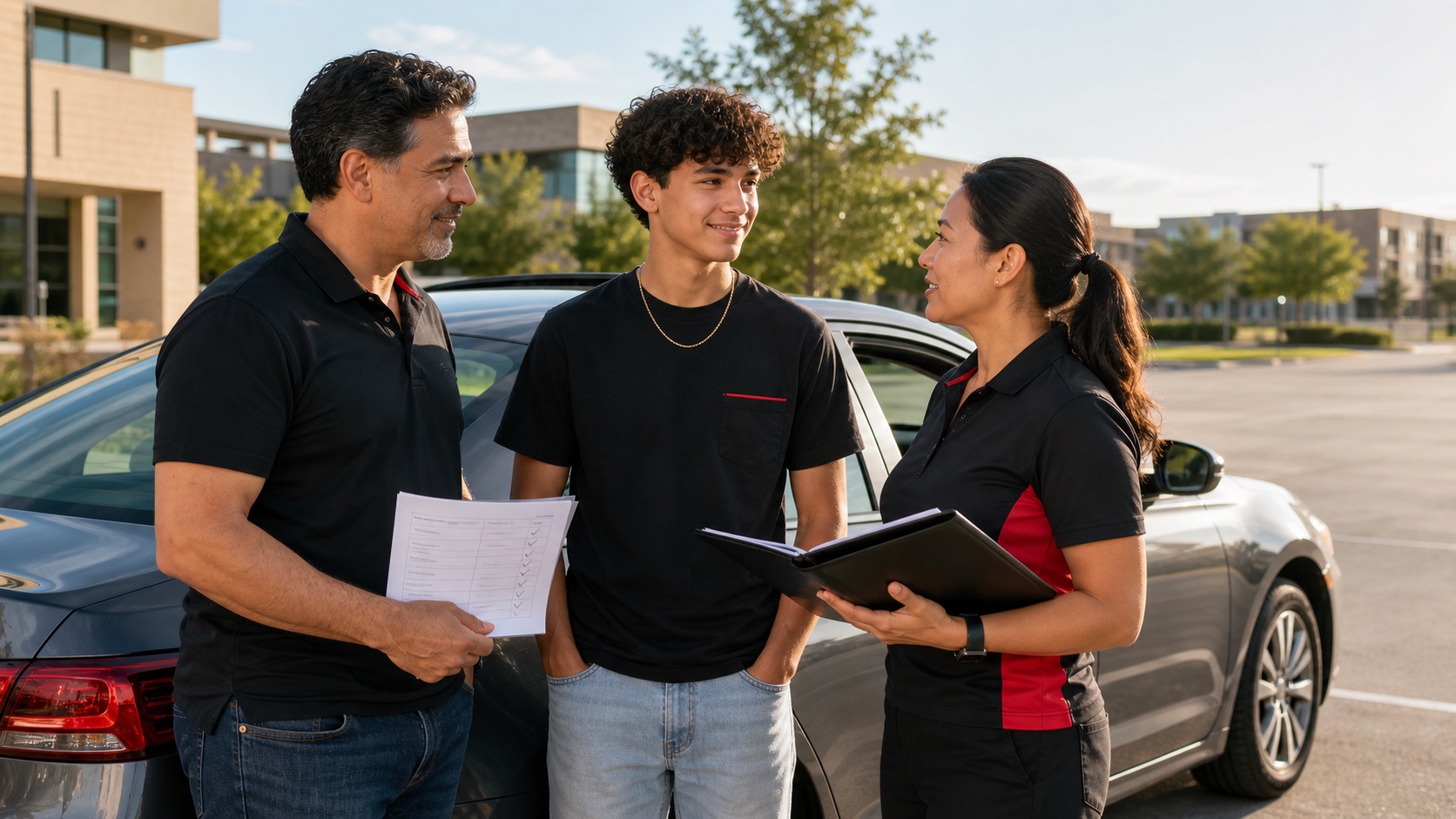
For Houston families, the number can sound simple until scheduling begins. Which hours belong to the driving school? Which hours can a parent supervise? Does a long Sunday drive count as several hours? And what has to happen before a teen can take the road test?
The safest way to plan is to separate the requirement into three distinct learning experiences. Each one develops something different: observation builds awareness, instructor time develops and checks technique, and supervised practice builds repetition across real conditions.
Watch instructor-led lessons and learn how decisions, corrections, and hazards are handled.
Drive and demonstrate required skills with a qualified driver-education instructor.
Practice with an eligible adult; at least 10 hours must take place at night.
What each part is designed to do
Seven hours of observation
Observation is active learning, not simply sitting in a vehicle. The student watches how an instructor introduces a maneuver, where another learner looks, when the instructor intervenes, and how a small decision can change the safety of the whole situation. Parents can reinforce the value by asking the teen to name one good decision and one avoidable mistake after each observation period.
Seven hours driving with an instructor
This is the professional instruction portion. A trained instructor can identify habits that are difficult for a family member to see from the passenger seat, such as late mirror checks, inconsistent lane position, rushed turns, incomplete scanning, or hesitation that creates a new hazard. The goal is not just to complete a clock requirement; it is to establish repeatable, safe technique.
SafeX Driving School can help Houston-area families organize instructor-led driving around the student's current ability. If a teen already has a learner license or is transferring driver-education records, the office can review the situation and explain which SafeX services may fit. The original course provider and Texas licensing authorities remain the final source for certificate and eligibility decisions.
Thirty hours of supervised practice
The official Texas practice log says the 30 hours must be completed with an adult who is at least 21 and has been licensed for at least one year. At least 10 hours must be at night. It also says that only one hour per day counts toward the 30-hour total, even if the teen drives longer that day.
That one-hour rule changes the planning. Thirty hours cannot be completed legitimately in a few long weekend drives. Families need a series of dated practice sessions, which is useful because safe judgment develops through repeated exposure over time.
Build 30 hours around skills, not errands
A practice log can be complete while a student is still unprepared if every drive follows the same easy route. Houston-area practice should gradually include different traffic patterns, road types, and decision loads. Start in a controlled environment and add complexity only when the teen can manage the current level calmly.
- Vehicle setup and control. Seat, mirrors, smooth starts and stops, steering, lane position, and consistent observation habits.
- Low-speed maneuvers. Backing, parking, turns, right-of-way decisions, neighborhood scanning, and safe speed selection.
- Multi-lane roads. Lane changes, mirror and blind-spot routines, following distance, traffic-light decisions, and communicating early.
- Night conditions. Visibility, glare, speed choice, following distance, pedestrians, and recognizing hazards beyond the headlight beam.
- Houston complexity. Busier corridors, changing speed limits, freeway entry and exit when the student is ready, and calm rerouting after a missed turn.
A better weekly practice rhythm
- Use two or three shorter, focused sessions instead of one exhausting drive.
- Choose one primary skill for each session and one familiar skill to maintain.
- Include both familiar roads and carefully selected new conditions.
- End with a two-minute review: what improved, what felt uncertain, and what comes next.
- Ask an instructor for a skills assessment when progress stalls or the family is unsure what to practice.
Where the learner license fits
Texas DPS says a teen may begin the classroom phase at age 14 but cannot apply for a learner license until age 15. Under the concurrent method, the learner-license path begins after the first 6 classroom hours and the knowledge exam; the remaining 18 classroom hours continue afterward. Under the block method, all 24 classroom hours are completed before the learner-license step.
While driving with a learner license, the teen must have a licensed adult age 21 or older in the front passenger seat. Texas DPS also prohibits cellphone use, including hands-free use, except in an emergency.
Before the provisional license and road test
Texas DPS currently lists these major milestones for a teen provisional license: be at least 16, hold the learner license for at least six months, complete the state-approved classroom and in-car driver education, complete Impact Texas Teen Drivers, and pass the driving test.
ITTD should come near the end. DPS says it is a separate requirement completed after the required driver education and behind-the-wheel work, and its certificate must be dated within 90 days of the skills test. Completing it too early can mean having to repeat it before a rescheduled test.
Minimum hours do not always equal road-test readiness
The state requirement is a minimum framework. A teen who has completed the hours may still need more work on judgment, consistency, or a specific maneuver. Extra practice is reasonable when the student still needs frequent reminders, becomes overloaded in ordinary traffic, misses hazards, or cannot repeat a skill reliably on a different road.
A focused professional lesson can be more useful than adding random practice. SafeX can assess the student's current habits, identify the highest-priority gaps, and recommend a practical next lesson plan. The recommendation is about readiness and skill development; it is not a guarantee of a test result.
Common questions
Does a Texas teen need 44 hours behind the wheel?
The complete in-car structure totals 44 hours, but it is not 44 hours of the teen driving with a school instructor. Current DPS guidance separates it into 7 observation hours, 7 instructor driving hours, and 30 supervised practice hours.
Can more than one practice hour count in a day?
The official Texas 30-hour practice log says only one hour per day counts toward the 30-hour requirement, regardless of how long the student drives that day.
Who can supervise the 30 practice hours?
The TDLR practice guide says the supervising adult must be at least 21 and have been licensed for at least one year. The adult should remain attentive and able to provide safe guidance throughout the drive.
How many nighttime hours are required?
At least 10 of the 30 supervised practice hours must be completed at night.
When should we ask for extra instructor time?
Consider a professional assessment when the teen needs repeated intervention, struggles with a specific environment, has stopped progressing, or the family is unsure whether the student's habits are test-ready.
Official sources
- Texas DPS: Texas Learner License as a Teen
- Texas DPS: Texas Provisional License as a Teen
- Texas DPS: Choosing a Driver Education Course
- TDLR: Texas 30-Hour Behind-the-Wheel Guide and Practice Log
- Texas DPS: Impact Texas Teen Drivers FAQ
Build a clearer plan for your teen
Call SafeX Driving School in Katy to discuss teen behind-the-wheel instruction, a focused skills assessment, or the next practical step for a student who already has a Texas learner license.
Call 346-425-6794This article provides general educational information and was reviewed against the linked Texas DPS and TDLR materials on August 22, 2026. Requirements, terminology, and provider procedures can change. Confirm the student's exact record and eligibility with the original course provider and the appropriate Texas authority.